
Pablo Escobar is one of the most written-about criminals of the twentieth century. Yet some of the numbers most closely associated with him are surprisingly difficult to trace.
Did the Medellín Cartel really move 15 tons of cocaine every day? Did Escobar personally earn $21.9 billion a year? Did rats destroy $2.1 billion of his cash? And did Forbes actually rank him as the seventh-richest person in the world?
We traced 20 widely repeated claims through contemporary newspapers, historical Forbes material, Colombian reporting, government records, institutional documents, biographies, memoirs and later media accounts. The goal was not to produce another list of “crazy Pablo Escobar facts,” but to find out where the claims came from and how their meaning changed as they spread.
Pablo Escobar Source Audit: 20 claims traced · 45 retained sources · contemporary records prioritized · last reviewed August 2026
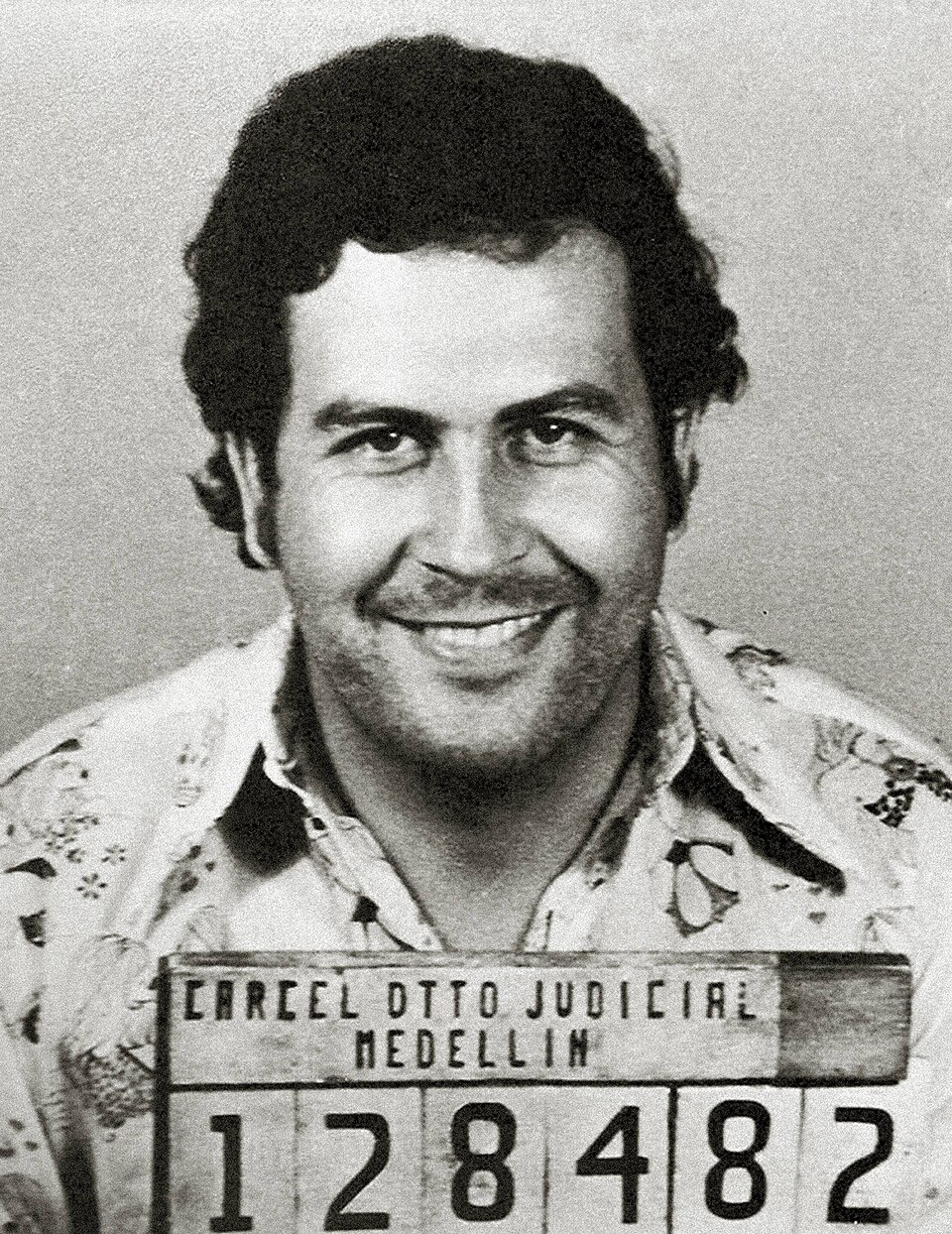
The Five Biggest Findings
| Common claim | What the source trail shows | Verdict |
|---|---|---|
| 15 tons of cocaine every day | Contemporary 1987 reports used the same 15-ton figure per month, not per day. | Likely misleading |
| $21.9 billion in personal income | An older cartel-revenue estimate annualizes to exactly $21.9 billion; later versions present it as Escobar’s personal income. | Misleading / unsupported |
| $2.1 billion eaten by rats | A claim that about 10% of stored cash was lost was later converted into a precise dollar figure and narrowed to rats alone. | Misleading |
| Forbes: $30 billion / #7 richest | Forbes’ historical record gives Escobar about $3 billion in 1989, below even the threshold for the global top ten. | Contradicted by the 1989 record |
| Escobar’s personal death toll | Estimates of murders ordered and wider narcoterrorism-era victim totals are often turned into personal kill counts. | Misleading |
How Escobar Numbers Turn Into “Facts”
The recurring problem is not simply that people invent numbers. More often, a real number survives while the definition around it disappears.
- Unit drift: per month becomes per day.
- Subject drift: cartel revenue becomes Pablo Escobar’s personal income.
- Derived arithmetic becomes historical fact: a percentage or daily estimate is converted into a new figure that is later repeated as though it came from the original source.
- Attribution disappears: “may have ordered” becomes “killed.”
- Scope changes: an era-wide victim total becomes one man’s death toll.
- Chronology collapses: a real photograph from 1981 is combined with Escobar’s much later fugitive status.
$60 million per day → $420 million per week → $21.9 billion per year → “Escobar’s personal income”
That is why this audit uses verdicts such as Needs context, Disputed and Anecdotal instead of forcing every story into a simple true-or-false answer.
Money, Cocaine and the Famous Numbers
1. Did the Medellín Cartel Really Move 15 Tons of Cocaine Every Day?
Verdict: Likely misleading
The claim that the Medellín Cartel moved 15 tons of cocaine every day is now one of the most familiar statistics attached to Escobar. Contemporary reporting used a different unit.
In February 1987, TIME reported allegations that the cartel was smuggling up to 15 tons per month into the United States and Europe. Later that year, another TIME report described Carlos Lehder’s aircraft as bringing about 15 tons every month into the United States.
Later secondary material began using the same number as 15 tons per day.
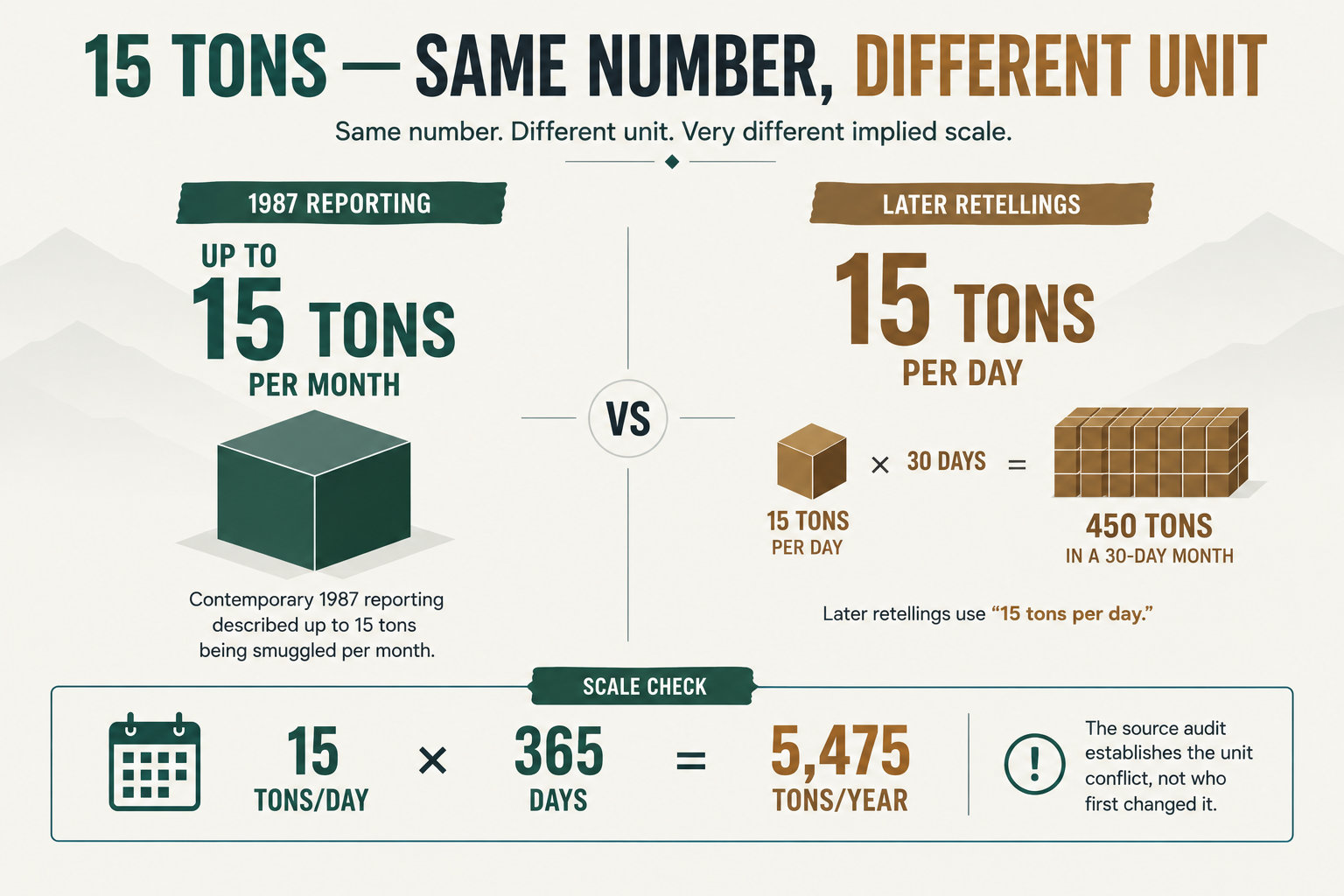
We have not established who first changed the unit, or whether the monthly and daily claims developed independently. The evidence therefore does not justify calling it a documented typo or copying error.
The daily interpretation also creates a major scale problem:
Historical U.S. government estimates put potential Andean cocaine production at roughly 750–775 metric tons annually around the end of the 1980s. The figures are available in historical data compiled by the Office of National Drug Control Policy.
Large individual shipments were possible, and seizures of roughly that scale did occur. The problem is treating 15 tons as a sustained daily rate.
2. Did the Medellín Cartel Make $420 Million Every Week?
Verdict: Unverified high-end estimate
A 2015 Daily Beast article states that the Medellín Cartel generated at least $420 million each week, but does not identify the underlying calculation.
An earlier figure has an exact mathematical relationship. In 2009, CNN repeated an estimate of roughly $60 million per day for Colombian cartels:
$60 million × 7 = $420 million.
That equivalence does not prove one source copied the other.
Contemporary estimates were also lower. A 1987 Los Angeles Times report discussed roughly $7 billion a year in U.S. revenue for the Medellín organization, while a 1988 New York Review of Books analysis put annual cartel revenue around $5–10 billion.
The $420-million weekly figure is best treated as a later high-end estimate whose original calculation remains unresolved.
3. Did Pablo Escobar Personally Earn $21.9 Billion a Year?
Verdict: Misleading / unsupported as personal income
This is one of the clearest examples of a number changing meaning without changing mathematically.
× 365 days
= $21.9 billion per yearWhat changed was not the arithmetic — it was the subject.
The earlier $60-million figure referred to cartel or Colombian-cartel revenue. Later articles describe the annualized result as Pablo Escobar’s personal income.
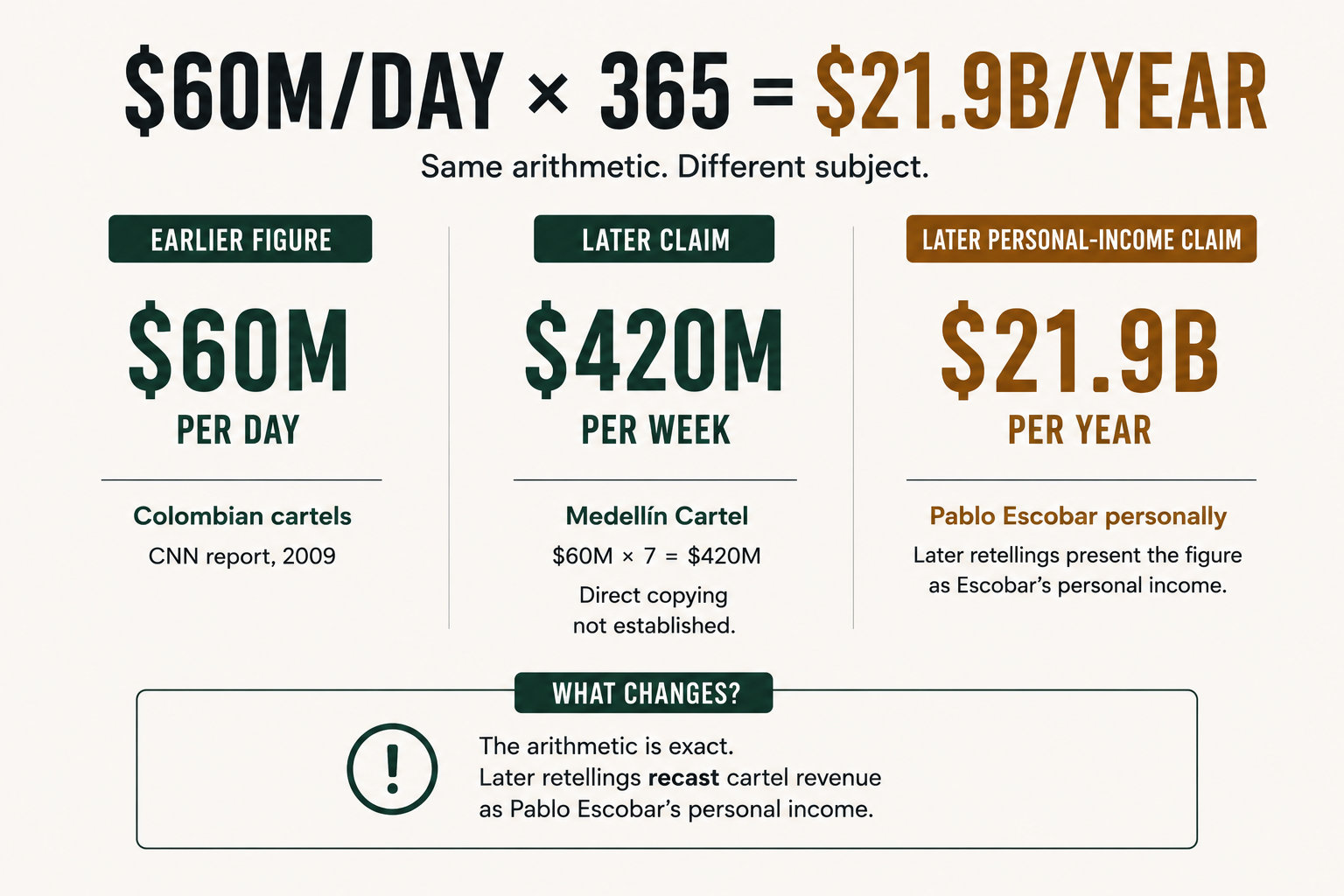
Those are not equivalent. Cartel revenue had to cover suppliers, transportation, pilots, distributors, employees, money laundering, losses and partners.
Historical Forbes material provides useful context. A Forbes retrospective of its 1987 billionaire issue says Escobar’s net worth was estimated at more than $2 billion and discusses several billion dollars in cash flow attributable to him over a period of years.
U.S. government research provides another scale check: American retail spending on cocaine was estimated at roughly $22.9 billion in 1988 and $22.5 billion in 1989.
A claim of $21.9 billion in Escobar’s personal annual income would therefore put one individual’s income close to the estimated value of the entire U.S. retail cocaine market.
4. Did Rats Eat $2.1 Billion of Escobar’s Cash Every Year?
Verdict: Misleading derived calculation
The story has a traceable source. The famous dollar amount does not.
Roberto Escobar, Pablo’s brother and former accountant, claimed that roughly 10% of stored cash could be lost to spoilage, including problems such as rats and dampness.
↓
later high-end revenue estimate
↓
approximately $2.1 billion
↓
“Rats ate $2.1 billion every year”
The $2.1-billion figure is therefore a later calculation, not a dollar amount Roberto Escobar gave for rat damage.
The Independent, for example, explicitly converts the percentage into a monetary loss based on a separate estimate of Escobar’s revenue.
Two transformations occur: an unverified insider estimate becomes an exact-looking dollar figure, and several forms of spoilage become rats alone.
5. Did the Cartel Spend $2,500 a Month on Rubber Bands?
Verdict: Anecdotal but traceable
This number can be traced directly to Roberto Escobar’s account. Material associated with The Accountant’s Story attributes to him the claim that around $2,500 per month was spent on rubber bands used to bundle cash.
No independent cartel accounting record confirming the expenditure was located for this audit.
It is best described as a traceable insider claim, not an audited financial fact.
6. Did Forbes Value Pablo Escobar at $30 Billion in 1989?
Verdict: False as a Forbes attribution
This audit is not claiming that nobody ever estimated Escobar’s hidden fortune above $3 billion. The narrower question is whether Forbes itself valued him at $30 billion in 1989.
1989: about $3 billion
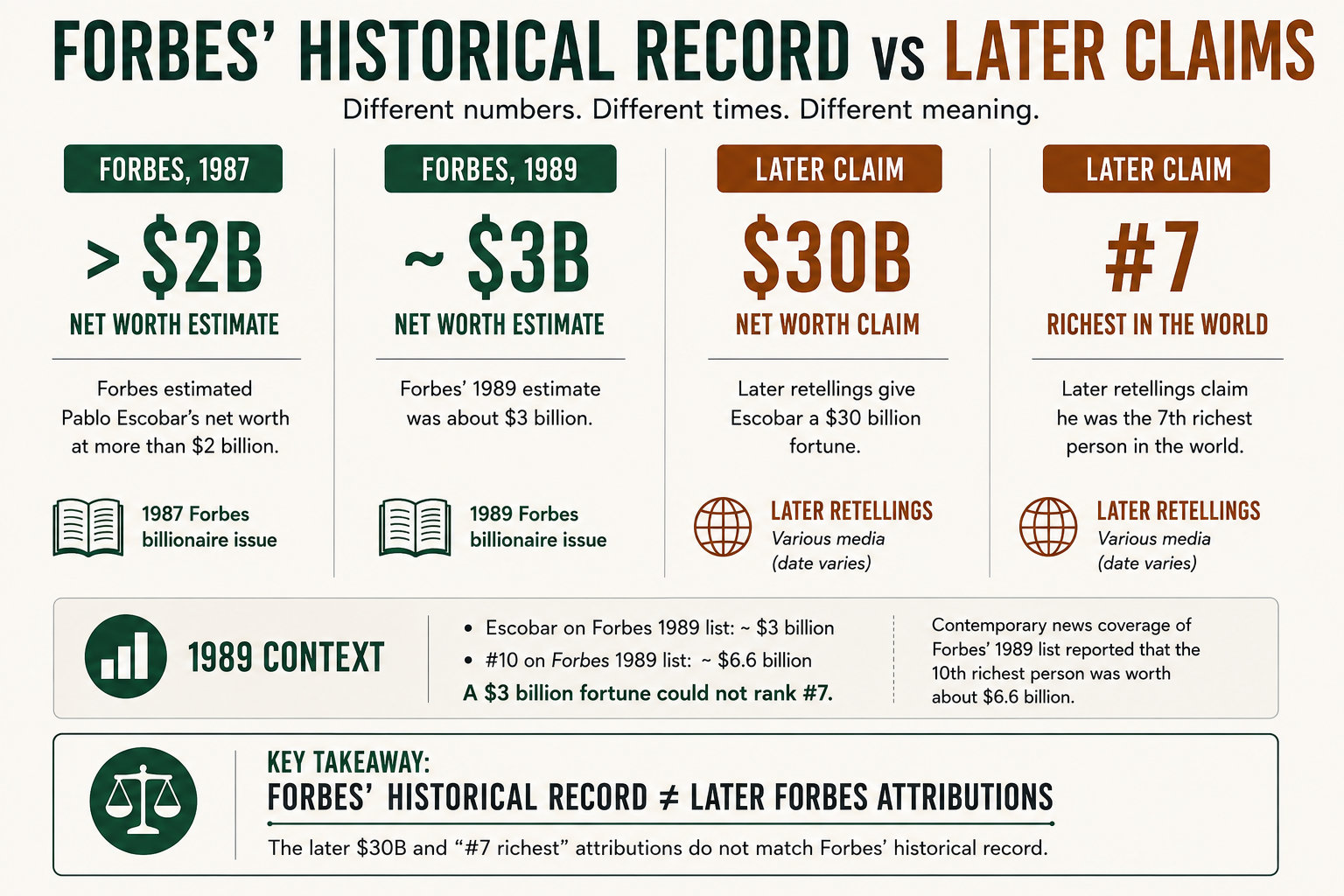
Forbes’ historical archive gives Escobar an estimated 1989 net worth of about $3 billion.
Contemporary Associated Press coverage of the Forbes list, published by the Los Angeles Times, reported the same estimate.
The much larger $30-billion figure became attached to Forbes later. A striking example is a 2017 Forbes contributor article that itself repeated the later $30-billion story.
A contributor article carrying the Forbes brand does not change what the historical Forbes list reported.
7. Did Forbes Rank Escobar as the Seventh-Richest Person in 1989?
Verdict: False as a 1989 Forbes ranking
We have not established where the famous “seventh-richest” ranking originated. But it conflicts with contemporary coverage of the actual 1989 Forbes list.
The Associated Press reported Escobar’s estimated fortune at $3 billion. The tenth-richest fortune on the same list was roughly $6.6 billion.
A $3-billion fortune could therefore not have placed Escobar seventh.
Contemporary Le Monde reporting similarly placed the Colombian drug barons around twentieth rather than inside the top ten.
The source of the “#7” story remains unresolved. What the evidence does rule out is #7 as Escobar’s actual 1989 Forbes ranking.
8. Did Escobar Control 80% of the World’s Cocaine?
Verdict: Needs context
The 80% figure is not simply a later internet invention.
In December 1986, TIME reported a federal allegation that Escobar and his associates controlled up to 80% of the world’s cocaine trade.
Another TIME report in 1987 used roughly 80% for the U.S. cocaine trade, while other contemporary accounts used similar percentages for cocaine entering the United States from Colombia.
The percentage survived while the denominator shifted — world trade, U.S. trade, or cocaine entering the United States.
Modern wording often preserves the 80% while dropping the distinction.
Violence, Politics and Death
9. Did Pablo Escobar Kill 4,000 People?
Verdict: Misleading
A 1998 profile in Semana reported that Colombian anti-narcotics experts estimated Escobar may have ordered around 4,000 murders between 1984 and 1993.
↓
“responsible for 4,000 murders”
↓
“Escobar killed 4,000 people”
The original wording contains two qualifications that later versions often lose: it was an estimate, and it referred to murders he allegedly ordered.
The 4,000 figure is therefore better described as an estimate of murders allegedly ordered or attributed to Escobar, not a documented personal kill count.
10. Where Does the 46,612 Escobar Death-Toll Figure Come From?
Verdict: Misleading if attributed to Escobar alone
The figure 46,612 appears in institutional material connected with Medellín’s attempt to memorialize victims of the narcoterrorism era.
Material from the Universidad Nacional de Colombia describes the number in the context of victims of narcoterrorist and drug-cartel violence across the period.
It was not constructed as a verified personal Pablo Escobar death toll.
The problem appears when the wider historical figure is compressed into a much stronger statement such as “Escobar was responsible for 46,612 deaths.”
The memorial number is better understood as an era-wide figure associated with broader narcoterrorist and cartel violence.
11. Did Pablo Escobar Finance the Palace of Justice Siege?
Verdict: Disputed
On 6 November 1985, members of the M-19 guerrilla movement seized Colombia’s Palace of Justice. A long-running theory holds that Escobar financed the operation in exchange for the destruction of extradition-related records.
The historical evidence does not support a simple verdict.
The Colombian Truth Commission report records testimony and evidence supporting a financial link between narcotrafficking interests and elements of M-19.
Other Colombian institutional positions disputed that interpretation, and former M-19 participants have denied that Escobar financed or ordered the assault.
This is not a good candidate for a confident “true” or “false.” The financing allegation remains disputed.
12. Did Escobar Offer to Pay Colombia’s National Debt?
Verdict: Supported with context
This is one of the Escobar stories whose core is well supported by contemporary reporting.
A Washington Post report describes cartel leaders proposing to pay Colombia’s national debt, then estimated at more than $9 billion.
The popular version usually removes the conditions. It was not a philanthropic offer by Escobar to rescue the Colombian economy; it formed part of negotiations in which cartel leaders sought legal concessions and protection from extradition.
The core event is supported. The heroic-sounding version is incomplete.
13. Did Pablo Escobar Kill Himself?
Verdict: Disputed
The suicide theory appeared almost immediately after Escobar’s death.
On 6 December 1993, a Reuters report reproduced by El Tiempo quoted relatives saying Escobar had killed himself rather than allow himself to be captured.
Colombian forensic and prosecutorial authorities reached a different conclusion.
A contemporaneous El Tiempo report said Fiscalía and Medicina Legal concluded that Escobar was killed by Search Bloc fire. The forensic account described three gunshot wounds and said the head wound lacked signs expected from a close-contact suicide shot.
Escobar’s son later continued to support the family version, saying his father had long said he would shoot himself rather than be captured.
The suicide theory therefore remains a family-supported alternative to the contemporaneous official forensic conclusion rather than an established explanation of Escobar’s death.
14. Did 25,000 People Attend Escobar’s Funeral?
Verdict: Needs context
The crowd around Escobar’s funeral and burial was large, but the familiar attendance figure is more precise than the contemporary evidence.
Associated Press reporting published on 4 December 1993 said police estimated that roughly 20,000 people came to the cemetery. Reporters estimated about 2,000 were present at any one time. The report is preserved in the Los Angeles Times archive.
Later accounts commonly give 20,000–25,000. The surviving contemporary estimates do not support treating 25,000 as a precise documented attendance figure.
15. Was La Catedral Really Escobar’s Private Luxury Prison?
Verdict: Largely supported
Unlike several famous Escobar statistics, the core La Catedral story holds up well.
Contemporary Washington Post reporting described confinement conditions heavily shaped by Escobar and far removed from ordinary incarceration.
Reports from the period describe comfortable rooms, communications equipment and extraordinary freedom within the facility. Later reporting documented additional luxury amenities.
Individual claims about every feature of La Catedral should still be sourced separately, but describing it as an unusually luxurious prison built around conditions negotiated by Escobar is well supported.
Childhood, Family and Medellín
16. Did Pablo Escobar Grow Up in Extreme Poverty?
Verdict: Misleading
The familiar story presents Escobar as a child of extreme poverty who rose from almost nothing to enormous wealth. The biographical evidence reviewed for this audit does not support that simple picture.
Mark Bowden’s research describes Escobar’s father as owning a house, agricultural land and cattle, while his mother worked as a teacher and helped establish a school. A version published by The Observer describes the family as comparatively comfortable by local rural standards.
This does not mean Escobar grew up wealthy or belonged to Colombia’s elite. It means “extreme” or “abject” poverty is stronger than the biographical evidence reviewed here supports.
17. Did Escobar Begin His Criminal Career by Stealing Gravestones?
Verdict: Disputed
The story is memorable: a young Escobar supposedly stole cemetery headstones, removed the names and sold them again.
Later biographies repeat it, but this audit did not locate a primary police or court record establishing the scheme. Escobar and his mother denied versions of the story, while Mark Bowden treated it skeptically.
That does not prove it never happened. It does mean the gravestone story should not be presented as an established first chapter of Escobar’s criminal career.
18. How Many Houses Did Pablo Escobar Actually Build?
Verdict: Source conflict / unresolved
A common modern explanation says Escobar originally built roughly 400–443 homes and that the famous 4,000 figure appeared only after the surrounding neighborhood expanded. The historical source trail is not that simple.
TIME was already describing 4,000 red-tiled homes in December 1986.
Other sources give substantially different figures:
- El País in December 1993 described a settlement of around 780 homes.
- El Tiempo later reported that around 1,000 homes had been planned but 443 were delivered.
- Other Colombian reporting refers to roughly 443 initial homes and a neighborhood that later grew to around 4,000 dwellings.
The discrepancy may reflect planned homes, completed units, occupied properties, later construction or changing neighborhood boundaries.
What we cannot responsibly do is reduce the conflict to a neat “443 became 4,000” myth. The 4,000 figure was already circulating contemporaneously.
For more on the neighborhood itself, see our guide to Barrio Pablo Escobar in Medellín.
19. Did Escobar Burn $2 Million to Keep His Daughter Warm?
Verdict: Anecdotal family testimony
In 2009, El Espectador reported an account from Escobar’s son, Juan Pablo Escobar — later Sebastián Marroquín — saying roughly $2 million in cash was burned while the family was hiding in order to keep his sister Manuela warm.
No independent contemporaneous confirmation was located for this audit.
The story has clear provenance, but weak independent verification.
20. Did Escobar Visit the White House While He Was America’s Most-Wanted Drug Lord?
Verdict: Misleading viral framing
The photograph is real. The chronology attached to it is the problem.
↓
Escobar’s later fugitive and “most wanted” reputation
↓
“Escobar visited the White House while America was hunting him”
The well-known photograph shows Escobar with his son outside the White House during a family trip in 1981.
Escobar’s major U.S. legal problems and fugitive status came later. A Washington Post report from July 1984, for example, covers a major U.S. drug-trafficking indictment involving Escobar and other traffickers.
The photograph also does not demonstrate an official White House meeting or invitation. It is an exterior photograph, not evidence that Escobar was received by the U.S. government.
The viral version combines a genuine 1981 image with a status Escobar acquired later.
What This Audit Actually Shows
The surprising result is not that every famous Pablo Escobar story is false. Several seemingly unbelievable stories are substantially supported, while others remain genuine historical disputes.
The more common problem is loss of context: estimates become exact numbers, cartel revenue becomes personal income, family testimony becomes documented fact, and wider historical victim totals become individual death tolls.
The number often survives longer than the definition that originally made the number meaningful.
How We Checked the Claims
This project prioritizes contemporary and near-primary sources where they are available.
Sources were generally assessed in this order:
- government, court and official institutional records;
- contemporary major newspaper and magazine reporting;
- researched academic and historical work;
- participant, family and memoir testimony;
- later secondary reporting;
- tertiary reference pages and listicles.
This is a source-proximity hierarchy, not a rule that every source higher on the list is automatically more accurate for every question. Family testimony, for example, can be the best evidence for where a story originated while remaining weak evidence that the event itself happened exactly as described.
Three Different Questions
For each claim, we tried to separate three issues:
- What is the earliest exact version of the claim we found?
- Is there an earlier precursor containing the same number, premise or wording?
- What evidence supports, contradicts or qualifies it?
Chronology and mathematical similarity do not by themselves prove copying. The fact that $60 million per day equals $420 million per week, for example, does not establish that one publication copied the earlier figure and multiplied it by seven.
Download the Pablo Escobar Myths Dataset
Pablo Escobar Source Audit
20 claims · 45 retained sources · verdict confidence · provenance notes · exact-claim and precursor dates · claim-source relationships
Corrections and Earlier Sources
Source tracing is rarely finished forever. Several claims in this audit have an identifiable early source without a proven point of origin.
If you know of an earlier newspaper article, court document, government record, book edition or other primary source, we would be interested in seeing it.
We are particularly interested in earlier evidence for the 15-tons-per-day, $420-million-per-week, $30-billion Forbes attribution, seventh-richest and 25,000-funeral claims.
Last reviewed August 2026